Brazil 1994 Home
Brazil 1994 FIFA World Cup Home
The Umbro yellow shirt that carried Brazil back to the fourth star.
- Manufacturer
- Umbro
- Kit Type
- Home
- Competition
- FIFA World Cup
- Location
- United States
- Result
- CHAMPIONS
- Archive ID
- KM-BRA-1994-H
Design Story
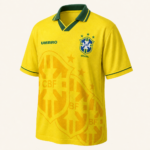
Brazil’s 1994 home shirt preserves the broad colour structure established during the 1950s while expressing it through the more graphic vocabulary of early-1990s football apparel. Umbro retained the yellow body, green neckline and green sleeve accents, but introduced a further visual layer through a large-scale, tonal pattern based on the national association’s emblem. [1][2]
The repeated shield forms differ in their function from the actual CBF badge on the chest. The badge identifies the organisation, whereas the enlarged tonal shapes act as a background graphic. Because the pattern remains close to the colour of the shirt itself, it adds complexity without competing directly with the yellow and green identity. The design can remain recognisable at a distance while offering a more intricate appearance when viewed closely.
The green V-neck and sleeve trim provide a defined boundary around the patterned field. Umbro’s chest branding and the association badge introduce smaller focal points, balancing the larger graphic with the conventional identifiers of an international football shirt. Period photographs and the Museu do Futebol’s reference to a shirt worn by Branco during the championship provide evidence for the tournament-era appearance. [2][3]
The championship stars carry a particularly important chronological distinction. The shirt worn during the winning campaign represented Brazil’s three earlier world titles; a fourth star belongs to the design’s post-victory history. [1][4] Reading the stars in this way makes the visual identity a record of the team’s achievements at a specific point in time.
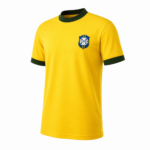
Compared with the relatively plain 1970 shirt, the 1994 design shows how national symbolism could move from a small crest and contrasting trim into the body of the garment. The later shirt does not abandon the earlier model of Brazilian identity; it makes that identity more decorative and layered. This combination of continuity and graphic experimentation gives the Umbro shirt a distinct place in the collection, independent of the result of the World Cup final.
Tournament & Historical Context
Brazil entered the 1994 World Cup in the United States after twenty-four years without a world title. Its qualifying campaign had been difficult, including a defeat by Bolivia and a decisive return to the side by Romário. Under Carlos Alberto Parreira, Brazil combined the attacking partnership of Romário and Bebeto with the midfield organisation associated with Dunga and Mauro Silva. [5]
The yellow shirt accompanied a championship campaign whose identity cannot be reduced to an uninterrupted sequence of flamboyant attacking performances. Brazil could produce expansive football when opportunities arose, but its success also depended on defensive control, patience and the ability to resolve tightly contested matches.
Brazil wore its blue away shirt in the quarter-final against the Netherlands and the semi-final against Sweden. The yellow home shirt returned for the final against Italy, where Brazil secured its fourth World Cup title after a penalty shoot-out. Although all three matches belong to the history of the championship campaign, they do not represent the same shirt's match usage. [5][6][7]
On 17 July at the Rose Bowl in Pasadena, Brazil faced Italy in a repeat of the 1970 final pairing. This time the match remained goalless after extra time. Brazil won the first World Cup final decided by penalties, prevailing 3–2 in the shootout after Roberto Baggio sent Italy’s final attempt over the goal. [7]
The celebration also connected football with a wider moment in Brazilian sporting life. The players displayed a tribute to Formula One champion Ayrton Senna, who had died earlier that year. The banner expressed a shared memory extending beyond the World Cup itself. [8] The shirt thus became associated not only with renewed football success but also with a moment of collective remembrance.
For KitMosaic, the 1994 home shirt forms a historical counterpart to the 1970 championship garment. The familiar national colours link two victories over Italy, separated by a generation and very different styles of final. Its significance lies in the return to championship success, the team’s collective resilience and the visual continuity of Brazil’s football identity.
- Competition
- 1994 FIFA WORLD CUP
- Location
- United States
- Result
- CHAMPIONS
Sources & Evidence
-
- True Colours Football Kits — Umbro Nations’ Collections: BrazilUmbro design chronology and pre-/post-title distinction.
-
- Museu do Futebol — Branco’s 1994 shirtMuseum object identification and tournament appearance.
- True Football Shirts — Brazil Home 1994Secondary visual reference for repeated CBF shield graphic and design details.
-
- Football Kit Archive — Brazil 1994 HomeYellow foundation, green V-neck and trim; tournament visual reference.
-
- Classic Football Shirts — Brazil 1994 Match IssueSecondary reference explicitly distinguishing the fourth star added after the victory; not proof of match wear.
-
- FIFA — Brazil at the World Cups: squads and resultsTwenty-four-year interval, knockout results and scorers.
-
- FIFA — Netherlands vs Brazil, 1994Brazil’s blue away shirt in the quarter-final, match chronology and celebration photography.
- Museum of Jerseys — Brazil and Sweden, 1994 World CupBrazil’s blue away shirt in the semi-final against Sweden.
-
- FIFA — Brazil’s World Cup finals1994 final, penalty shootout and 1970 comparison.
-
- Ayrton Senna — 1994 champions present tribute bannerDocumentation of the team’s tribute banner.