Brazil 1970 Home
Brazil 1970 FIFA World Cup Home
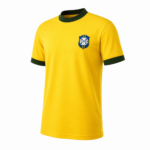
The canarinho shirt worn as Brazil became football’s first three-time world champion.
- Manufacturer
- Athleta
- Kit Type
- Home
- Competition
- FIFA World Cup
- Location
- Mexico
- Result
- CHAMPIONS
- Archive ID
- KM-BRA-1970-H
Design Story
Brazil’s 1970 home shirt is an example of national identity expressed through a deliberately economical colour arrangement. A broad field of yellow is framed by green at the round neckline and sleeve ends. Together with the historic CBD association badge, these elements create a concise visual identity whose recognisability does not depend on complex graphics or prominent manufacturer branding. Museum records of period garments and the documented appearance of the final shirt provide reference points for this design. [1][2]
The yellow shirt was not invented for the 1970 World Cup. Its origins lie in the reassessment of Brazil’s football identity after the defeat by Uruguay in 1950. A national design competition organised by the Brazilian sporting authorities and the newspaper Correio da Manhã produced the yellow-based uniform that replaced the established white home outfit. The winning proposal by Aldyr Garcia Schlee incorporated the colours of the national flag. [3] By 1970, yellow had already become a familiar symbol of Brazilian football.
The balance between the yellow body and green borders is central to the design’s visual strength. The two colours serve different functions: yellow establishes the dominant identity, while green provides definition at the edges. The historic association emblem is a relatively compact secondary element. This hierarchy makes the shirt readable at a distance and connects it to the wider yellow, green, blue and white palette of the national uniform.
The design also illustrates the importance of continuity across Brazil’s championship history. The 1958 final was played in blue rather than yellow, but the yellow home identity remained in place. [3] The 1970 garment can therefore be understood as the consolidation of an already established national design, not the introduction of a new championship colour scheme.
The absence of elaborate graphic treatment is part of its curatorial value. The shirt shows how a simple arrangement of national colours can acquire exceptional cultural significance through the football played in it and the images that preserve those achievements.
Tournament & Historical Context
Brazil entered the 1970 World Cup in Mexico having won the tournament in 1958 and 1962 but fallen short in 1966. Under Mário Zagallo, the team brought together Pelé, Gérson, Jairzinho, Rivellino, Tostão and other players whose combined abilities would define a new championship campaign. [4]
On 21 June 1970, Brazil faced Italy at the Estadio Azteca in Mexico City. Pelé opened the scoring with a header before Italy equalised through Roberto Boninsegna. Gérson and Jairzinho restored and extended Brazil’s advantage, and captain Carlos Alberto completed the 4–1 victory with the celebrated final goal of a coordinated team attack. The result made Brazil the first country to win three World Cups. [4][5]
The yellow shirt is especially closely associated with the images of that final. Its cultural reach derives in part from the character of the football it came to represent: individual invention operating within a collective attacking structure. Carlos Alberto’s goal offers a useful example, because the decisive finish was the culmination of contributions from several players rather than an isolated individual action. [4][5]
The championship also unfolded under Brazil’s military dictatorship, during the presidency of Emílio Garrastazu Médici. Historical scholarship documents how the authorities and portions of the media connected sporting success with official narratives of national unity and development. [6] This political context belongs alongside, rather than in place of, the sporting achievement and the experiences of Brazilian supporters.
The enduring public memory of the tournament is reflected in the preservation and exhibition of its garments. The Museu do Futebol has displayed a shirt identified as Pelé’s from the 1970 final within an exhibition tracing the history of Brazil’s yellow uniform. [1] This connection between the garment and museum interpretation illustrates how football apparel can become a vehicle for national historical memory.
Within the collection, Brazil 1970 Home represents the convergence of a mature national visual identity and a defining football achievement. It is an essential reference for understanding why the yellow shirt became so strongly associated with Brazil’s football culture beyond the particular players or results of any one tournament.
- Competition
- 1970 FIFA WORLD CUP
- Location
- Mexico
- Result
- CHAMPIONS
Sources & Evidence
-
- Museu do Futebol — Amarelinha exhibitionMuseum display of Pelé final shirt and yellow-shirt history.
-
- Christie’s — Brazil vs Italy 1970 final shirtCatalogue description of round neckline and historical CBD badge; attribution is the auction house’s statement.
- Museu do Futebol — The third-title shirtPeriod design reference attributed by the museum to Marco Antônio; not evidence that this particular garment was worn in the final.
-
- Museu do Futebol — History of the Canarinho shirtPost-1950 design history and national colour tradition.
- Museu do Futebol — Historical exhibition on Google Arts & CultureCompetition and 1958 final colour context.
-
- FIFA — Brazil’s World Cup finalsPlayers and collective attacking football.
-
- FIFA — Brazil vs Italy, Mexico 1970Final date, score, scorers and period photograph.
-
- Recorde — Football, politics and the press in 1970Scholarly analysis of political and media context.
- Recorde — Nationalism and censorship in the 1970 World CupIndependent scholarly context on authoritarian government and press.