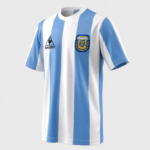
Argentina 1986 Home
Argentina 1986 FIFA World Cup Home
The shirt that needed almost nothing new to become immortal.
- Manufacturer
- Le Coq Sportif
- Kit Type
- Home
- Competition
- FIFA World Cup
- Location
- Mexico
- Result
- CHAMPIONS
- Archive ID
- KM-ARG-1986-H
Design Story
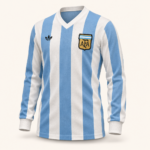
Argentina’s 1986 home shirt makes continuity its defining visual principle. The alternating sky-blue and white stripes establish a recognisable national identity before any individual emblem is read. Rather than treating the national colours as small decorative accents, the design allows them to organise the entire front of the garment. Its connection with the earlier championship shirt of 1978 is therefore apparent even without knowledge of the two tournaments. [1][2]
Le Coq Sportif supplied the national team in 1986, succeeding the adidas identity associated with the 1978 World Cup. The change in manufacturer is visible through the chest branding, but it does not displace the stripes as the dominant element. The white neckline and the association badge sit within a relatively restrained composition, allowing the repeated vertical bands to remain the principal graphic device. [1][2]
This restraint is particularly striking when the home shirt is considered alongside Argentina’s blue away outfit from the same tournament. One expresses national identity through a recurring striped pattern, while the other relies primarily on a single field of blue. The two designs demonstrate that a national team’s visual vocabulary can extend beyond its most familiar home colours without losing its connection to the team. [3]
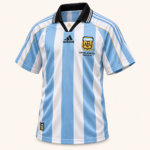
The later adidas home shirt of 1998 retained the vertical stripes but introduced a more emphatic black collar and central manufacturer branding. [4] In that sequence, the 1986 garment offers an intermediate reference point: the national pattern remained stable even as the surrounding design vocabulary changed.
The shirt’s place in a curated collection is not dependent solely on its association with Diego Maradona. Its visual economy illustrates the resilience of an established national football identity across different suppliers, generations and championship campaigns.
Tournament & Historical Context
Argentina returned to the World Cup final in Mexico in 1986, eight years after winning its first title at home. Under Carlos Bilardo, the side was organised around Diego Maradona’s creative ability, but its eventual success also depended on the contributions of a disciplined supporting team. The striped shirt became the visible link between the first championship generation and the second. [1][5]
The distinction between Argentina’s home and away garments matters when interpreting the tournament. Maradona’s two celebrated goals against England on 22 June, including the controversial handball and the solo run, were scored in a blue away shirt. Those moments belong to the wider campaign, not to the specific striped garment represented in this archive. [3][5]
Three days later against Belgium, Maradona scored both goals in a 2–0 semi-final victory. The striped home shirt was also worn in the final against West Germany on 29 June at the Estadio Azteca. José Luis Brown and Jorge Valdano established a two-goal advantage before Karl-Heinz Rummenigge and Rudi Völler brought West Germany level. Maradona then released Jorge Burruchaga, whose winning goal secured the 3–2 result and Argentina’s second title. [5][6]
The final offers a more collective reading of the championship than the familiar emphasis on Maradona alone. Brown’s opening goal, Valdano’s finish and Burruchaga’s decisive run were all parts of the same achievement. The home shirt records that shared sporting history as well as the exceptional leadership of its captain.
The championship also took place in a different political era from the 1978 tournament. Argentina had returned to constitutional democracy in 1983. The two victories should not be treated as politically equivalent simply because their shirts share the same colours. [7]
Within the archive, the 1986 home shirt connects the first title of 1978 with the later international careers represented by the 1994 and 1998 garments. Its cultural significance comes from the persistence of a national visual identity through a period of profound change, and from the collective achievement that made the stripes part of a second championship memory.
- Competition
- 1986 FIFA WORLD CUP
- Location
- Mexico
- Result
- CHAMPIONS
Sources & Evidence
-
- AFA — History of the Argentina shirtNational striped identity and supplier chronology; inherited reference from Batch 01.
-
- Football Kit Archive — Argentina 1986 HomeStriped home design and Le Coq Sportif attribution.
-
- Museum of Jerseys — Argentina 1986Blue away shirt distinction and 1986 kit context.
-
- Football Shirt Culture — Argentina 1998 HomeComparative visual reference only.
-
- FIFA — Maradona, game by gameCampaign chronology, England, Belgium and final; period photography.
-
- FIFA — Argentina beat West GermanyFinal score and scorers.
- DFB — Argentina vs BelgiumSemi-final result.
-
- Government of Argentina — The History of Argentine DemocracyRestoration of democracy on 10 December 1983.
Supplementary sources
- AFA — Brillará Celeste y Blanca, por siempreOfficial account of the striped shirt’s history.
Evolution Line
-
1978
Argentina’s first World Cup title had already linked the striped home identity to championship memory.
-
Current
1986
The Le Coq Sportif shirt kept that continuity intact while Maradona’s generation made it globally definitive.
-
1998
At France 98, adidas kept the sky-blue and white stripes and added a dark fold-over collar, shoulder stripes and match-edition chest details.