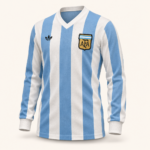
Argentina 1978 Home
The First Star
The long-sleeved blue-and-white shirt Argentina wore to win its first World Cup.
- Manufacturer
- Adidas
- Kit Type
- Home
- Competition
- FIFA World Cup
- Location
- Argentina
- Result
- Champions
- Archive ID
- KM-ARG-1978-H
Design Story
Argentina’s 1978 home shirt belongs to a visual tradition that is older than its first World Cup victory. The alternating sky-blue and white stripes translate the colours of the national flag into a recognisable football identity. Their vertical arrangement gives the shirt a continuous rhythm, making the national colours the dominant feature rather than a decorative addition. The Argentine Football Association traces this striped identity through the country’s World Cup history. [1]
The long-sleeved design represented here is associated with the 1978 final. Its white V-neck and cuffs provide a restrained frame for the stripes, while the adidas Trefoil and AFA shield establish separate manufacturer and national association identities. The crest appears without championship stars. This absence matters when the shirt is read retrospectively: the design belongs to the campaign that produced the first title, not to a later celebration of an established championship record. [2]
The balance between the stripes and the relatively discreet chest emblems illustrates a design approach in which national identity takes precedence over brand expression. The white neckline also maintains the continuity of the light palette rather than introducing a contrasting border that would compete with the body of the shirt.
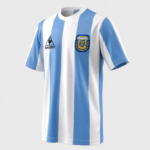
Comparison with the 1986 home shirt reveals how durable this visual formula proved to be. Le Coq Sportif replaced adidas as the supplier for the later championship, yet the striped composition remained immediately recognisable. [1][3] The two shirts are therefore best understood as different expressions of an established identity, rather than as unrelated designs from separate manufacturers.
For KitMosaic, the 1978 shirt is a foundational reference: its significance rests on the union of a restrained national design and the historical achievement that subsequently gave it new meaning.
Tournament & Historical Context
On 25 June 1978, Argentina defeated the Netherlands 3–1 after extra time at the Estadio Monumental in Buenos Aires. The victory gave the country its first World Cup title and established the striped home shirt as part of the visual record of a championship won in front of a domestic audience. [4]
César Luis Menotti’s team included captain Daniel Passarella and Mario Kempes, whose contribution proved decisive. Kempes opened the scoring in the final and struck again in extra time, before Daniel Bertoni completed the victory. With six goals across the tournament, Kempes finished as its leading scorer. The final photographs connect the long-sleeved blue-and-white design with the players who delivered that achievement. [2][4][5]
The tournament also took place under the military dictatorship that seized power in 1976. The regime sought to exploit the international competition for political legitimacy, while human rights campaigners challenged the image of national unity promoted by the authorities. The National Football Museum and Argentina’s National Historical Museum document these tensions through material relating to the event and its public reception. [6][7]
Understanding the shirt within this setting requires distinguishing the experiences of players and supporters from the political purposes of the regime. The joy of a first championship and the repression that surrounded the tournament are both part of its historical context. Neither should be erased by the other.
Eight years later Argentina won its second World Cup, in Mexico, wearing the same national colours under a different manufacturer. [1][4] The 1978 garment thus provides an essential starting point for understanding how a longstanding football identity became associated with world championship success.
Within this collection, the shirt is not simply a record of a winning score. It is a visual point of connection between national sporting achievement, collective memory and the difficult historical circumstances of the host tournament.
- Competition
- 1978 FIFA World Cup
- Location
- Argentina
- Result
- Champions
Sources & Evidence
-
- AFA — History of the Argentina shirtNational flag inspiration; striped tradition; suppliers in 1978 and 1986.
-
- Football Kit Archive — Argentina 1978 HomeVisual design reference; white V-neck and cuffs, Trefoil and crest.
- Getty Images — Mario Kempes, 1978 World Cup finalContemporary final photograph; long-sleeved configuration.
-
- Football Kit Archive — Argentina 1986 HomeComparative design and manufacturer.
-
- FIFA — World Cup champions, 1930–19781978 championship and final.
- FIFA — Argentina World Cup historyChampionship chronology, squads and results.
-
- Library of Congress — Argentina 1978Menotti, Passarella and Kempes as leading scorer.
-
- National Football Museum — Protest and the 1978 World CupDictatorship, propaganda and human rights protest.
-
- Museo Histórico Nacional — Passion of MultitudesArgentine historical and cultural context.
Supplementary sources
- DFB — 1978 World Cup final match recordFinal score and match details.
- FIFA — 1978 top goalscorer archiveSupplementary source for the tournament’s top scorer.
- KitMosaic — Argentina 1986 HomeRelated collection entry for design comparison.
Evolution Line
-
Current
1978
Argentina won its first World Cup in the sky-blue and white stripes, making this adidas home shirt a reference point for later title-winning kits.
-
1986
Le Coq Sportif kept the sky-blue and white vertical stripes for Argentina’s second World Cup title. The supplier changed while the home identity stayed recognizable.