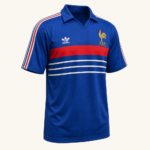
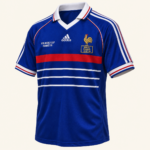
France 1998 Home
France 1998 FIFA World Cup Home
The blue adidas shirt from France’s first world title on home soil.
- Manufacturer
- Adidas
- Kit Type
- Home
- Competition
- FIFA World Cup
- Location
- France
- Result
- CHAMPIONS
- Archive ID
- KM-FRA-1998-H
Design Story
France’s 1998 home shirt brings a familiar national colour scheme into a composition with an unusually strong horizontal emphasis. The blue foundation remains the dominant element, but a red chest band and narrow white lines introduce a graphic structure that can be recognised even when the association crest and player identification are not visible. [1]
This arrangement has a significant precedent in the adidas shirt worn when France won the European Championship in 1984. That earlier design also used a broad red band and fine white stripes against a blue field. [2] The 1998 shirt reinterprets the same visual relationship rather than reproducing every element of the older garment. It therefore provides a useful example of how a national team's design history can become part of a new championship identity.
The white fold-over collar and the tricolour shoulder details extend the national palette beyond the chest graphic. The association’s cockerel supplies another established French symbol, while the geometric adidas branding belongs to the sportswear vocabulary of the late 1990s. Contemporary World Cup designs placed the manufacturer’s mark centrally, allowing the chest identifiers and horizontal bands to form a more balanced composition. [1][3]
The shirt can be read alongside other graphic treatments of national identity in the KitMosaic collection. Whereas the Germany 1990 home design uses angled flag-colour bands and the Netherlands 1988 shirt uses repeated geometric forms, the French design works through a largely horizontal arrangement. The comparisons demonstrate different ways of combining established national colours with increasingly distinctive football graphics.
The 1998 design also has a chronological significance: the team entered its home World Cup without a championship star above its crest. The first title would subsequently add a new element to France’s visual identity. [3][4] The garment’s importance is not simply that it preceded that addition, but that it connects two important home championships through a shared graphic language. The red band and white lines make historical continuity visible within a recognisably different late-1990s shirt.
Tournament & Historical Context
France hosted the 1998 FIFA World Cup with a team that combined experienced internationals and a younger generation of players under Aimé Jacquet. Its tournament followed the disappointment of failing to qualify for the 1994 edition and recalled the earlier triumph of Michel Platini’s generation at the European Championship in 1984. The return of a related visual design gave this new home campaign a distinctive historical resonance. [2][4]
France advanced through the group stage and then defeated Paraguay with Laurent Blanc’s golden goal. The quarter-final against Italy was resolved by a penalty shootout; however, the French players wore their white change shirt in that match, rather than the blue home design documented here. [2][4]
The blue shirt was worn in the semi-final against Croatia on 8 July, when Lilian Thuram scored twice to overturn Davor Šuker’s opening goal and secure a 2–1 victory. The unusual source of the two French goals illustrates the importance of contributions from across Jacquet’s squad. [5]
Four days later, at the Stade de France in Saint-Denis, France defeated Brazil 3–0. Zinedine Zidane scored twice from headers before Emmanuel Petit added a third goal in the closing stages. The victory gave France its first World Cup title and made the blue shirt the direct visual reference for the final. [4][6]
The championship also became a significant episode in debates about French national identity. The phrase Black-Blanc-Beur was widely associated with a team whose players came from diverse backgrounds. French immigration-history scholarship records the enthusiasm surrounding this image while also questioning the extent to which sporting success could resolve wider social inequalities. [7] The celebratory symbolism should therefore be distinguished from a claim that the victory ended discrimination.
Within KitMosaic, the 1998 home shirt preserves both a sporting breakthrough and a moment of cultural visibility. Its significance comes from the interaction of an established national design tradition, an exceptional collective achievement and a public discussion about belonging that continued long after the final whistle.
- Competition
- 1998 FIFA WORLD CUP
- Location
- France
- Result
- CHAMPIONS
Sources & Evidence
-
- Football Kit Archive — France 1998 World Cup HomeBlue field, red band, white lines, collar and trim.
-
- Museum of Jerseys — World Cup Classics: France 19981984 design relationship, tournament branding and quarter-final white kit.
- Football Kit Archive — France 1984 HomeEarlier championship design for comparison.
-
- Football Kit Archive — France 1998 World Cup FinalFinal design reference; compare star status and match imagery before production.
-
- FIFA — France’s World Cup titlesCampaign progression, championship chronology and first title.
-
- FIFA — Thuram sinks CroatiaSemi-final date, score and scorers.
-
- FIFA — World Cup championsFinal result and championship context.
-
- Library of Congress — World Cup 1998Social reception and Black-Blanc-Beur slogan.
- Musée national de l’histoire de l’immigration — Le métissage par le footCritical historical context for integration and its limits.