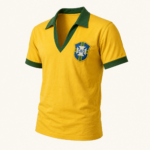
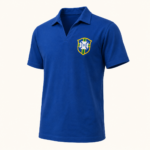
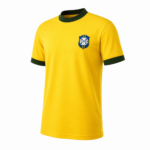
Brazil 1958 Blue Final Shirt
Brazil 1958 1958 FIFA World Cup Final S
The Emergency Blue Shirt
- Kit Type
- Special
- Competition
- FIFA World Cup
- Location
- Sweden
- Result
- CHAMPIONS
- Archive ID
- KM-BRA-1958-S
Design Story
The blue shirt worn by Brazil in the 1958 World Cup final is an unusual example of a garment whose historical importance exceeds the complexity of its design. Its defining feature is the substitution of a largely plain blue field for the yellow shirt that Brazil had been wearing through the tournament. The change responded to a practical problem: Sweden, the host nation and final opponent, also played in yellow. [1]
Contemporary final imagery and a shirt documented in a Christie’s auction catalogue show a short-sleeved design with a V-shaped neckline and the historical CBD badge. [2][3] With few competing decorative elements, the crest becomes a particularly important point of recognition. It identifies the national side even when the colour most immediately associated with Brazilian football is absent.
The use of blue did not require abandoning the national palette. Blue is already part of Brazil’s flag and was present in the established home uniform. Moving it from the supporting role of the shorts to the dominant field of the shirt creates a different hierarchy of colours while retaining a relationship with the country’s visual identity. [4] The distinction is important because the garment was not a rejection of the yellow home tradition.
In the museum's account of the final preparations, blue shirts were obtained shortly before the match and association badges were attached to them. [1] The appearance should therefore be understood in relation to the circumstances of a particular fixture, rather than as the product of a documented long-term design programme. Exact procurement details have been retold in different ways and are not necessary to establish the shirt’s identity.
Within KitMosaic, the blue garment is presented as a special historical entry alongside the yellow 1958 home shirt. Together they demonstrate how an unexpected change of colour can become a defining part of a national football vocabulary. The special shirt also offers a meaningful early reference for Brazil’s later blue change designs, without requiring the claim that blue had never been used before 1958.
Tournament & Historical Context
On 29 June 1958, Brazil met Sweden at Råsunda Stadium in Solna, near Stockholm. The hosts had reached their first World Cup final, while Brazil was attempting to win the trophy for the first time. Their shared preference for yellow created an unusual problem shortly before the most important match of the tournament. [1][5]
The Brazilian delegation resolved the colour conflict with a set of blue shirts. The Museu do Futebol recounts how the change subsequently acquired a religious association: according to a familiar tradition, delegation chief Paulo Machado de Carvalho connected the colour with the mantle of Our Lady of Aparecida. [1] This account belongs to the cultural memory surrounding the final; it should not be treated as a verified transcript of a team speech.
Sweden took an early lead through Nils Liedholm, but Brazil responded with two goals from Vavá before half-time. Pelé extended the advantage after the interval, and Zagallo added another goal. Agne Simonsson reduced the deficit for Sweden before Pelé completed the 5–2 scoreline. At seventeen, Pelé had become a central figure in the country's first championship. [5][6]
The final also represented a collective achievement. Vavá’s finishing, the contributions of the wide players and the organisation of the side were integral to the outcome. The images of captain Hilderaldo Bellini raising the Jules Rimet Trophy gave the new champions a lasting visual record, in which blue rather than yellow is the distinguishing shirt colour. [4][5]
The historical strength of the garment is precisely this contrast between expectation and memory. Brazil’s now familiar yellow identity accompanied its progress through the tournament, but the first championship was secured in a different colour. The blue shirt became memorable because it was part of the decisive event itself, rather than because it was the country’s ordinary home design.
KitMosaic retains both garments as complementary archives. The yellow home shirt communicates an emerging national identity; the blue special shirt captures the moment when a practical change became inseparable from Brazil’s first World Cup triumph.
- Competition
- 1958 FIFA World Cup Final
- Location
- Sweden
- Result
- CHAMPIONS
Sources & Evidence
-
- Museu do Futebol — A camisa número 18Final colour conflict, improvised blue shirts and explicitly legendary religious account.
-
- Christie’s — Blue Brazil v Sweden 1958 Final ShirtCatalogue description of blue short-sleeved V-neck CBD shirt. Player attribution is a catalogue claim, not independently certified here.
-
- Historical Football Kits — 1958 knockout stagesReconstructed kit comparison and source for final colour distinction.
-
- Museu do Futebol — Canarinho exhibitionNational colours and historical trophy imagery.
-
- FIFA — Brazil vs Sweden, 1958Final chronology, photography and match context.
- DFB — Brazil vs Sweden, finalResult and match record.
-
- FIFA — Pelé’s three titlesPelé’s age, goals and historical achievement.