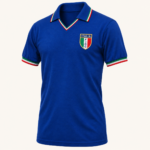
Italy 1982 Home
Italy 1982 FIFA World Cup Home
The blue Le Coq Sportif shirt from Italy’s third world title.
- Manufacturer
- Le Coq Sportif
- Kit Type
- Home
- Competition
- FIFA World Cup
- Location
- Spain
- Result
- CHAMPIONS
- Archive ID
- KM-ITA-1982-H
Design Story
Italy’s 1982 home shirt is built around a national sporting colour that does not appear in the country’s modern flag. The FIGC traces the adoption of blue to January 1911, when the national team first wore the colour associated with the House of Savoy. Blue subsequently became an enduring identifier of Italian sport. [1] By 1982, that tradition had acquired a meaning independent of its original dynastic context.
The Le Coq Sportif design retains a largely uninterrupted blue field. Its most distinctive accents appear around the neckline and sleeve cuffs, where narrow green, white and red bands introduce the colours of the Italian flag. The fold-over collar creates a more structured frame for the neckline than a simple round neck, and the small tricolour shield anchors the national identity on the chest. [2][3]
This combination is particularly interesting from a curatorial perspective. Blue supplies the dominant historical sporting identity, while the flag colours operate at a smaller scale. Neither needs to displace the other. The collar and cuff treatments link the peripheral details visually, leaving the centre of the shirt comparatively restrained. The appearance is recognisable without relying on large graphic devices or a prominent manufacturer’s mark on the players’ match shirts. [2][4]
The 1982 design can also be compared with the national team's earlier blue garments, including the shirt associated with the 1970 World Cup. The continued dominance of blue provides a common foundation; the more articulated collar and tricolour detailing mark a visible development in the shirt’s presentation. [3] Later Italian designs would interpret national colours more expansively, but the basic azzurro identity would persist. [1][5]
The value of the 1982 shirt is therefore different from that of the more graphically elaborate championship garments in this collection. Its distinctive character comes from the controlled placement of colour and the balance between two longstanding national symbols. The result demonstrates how a relatively minimal football shirt can still represent a specific moment in design history.
Tournament & Historical Context
Italy arrived at the 1982 World Cup in Spain seeking its first world championship since the consecutive titles of 1934 and 1938. Enzo Bearzot’s squad began without the form of an obvious tournament favourite, drawing its opening three matches against Poland, Peru and Cameroon. Its progress into the second group stage left the possibility of a very different campaign from the one that initially appeared likely. [6]
The turning point came in Barcelona. Italy defeated reigning champions Argentina 2–1 before meeting Brazil at the Estadi de Sarrià on 5 July. Wearing the blue home shirt, Italy won 3–2 through a Paolo Rossi hat-trick. Against an admired Brazilian side, the Italian performance demonstrated the relationship between collective discipline and the ability to exploit attacking opportunities. [6][7]
Rossi scored both goals in the 2–0 semi-final win against Poland. His decisive performances transformed the fortunes of the tournament and gave the blue shirt an association with one of the most striking individual reversals of form in World Cup history. His influence, however, was realised within a team whose organisation and collective effort were fundamental to its success. [6]
On 11 July, Italy faced West Germany at the Santiago Bernabéu in Madrid. After a goalless first half, Rossi opened the scoring, Marco Tardelli doubled the lead and Alessandro Altobelli added a third. Paul Breitner scored West Germany’s consolation goal in a 3–1 Italian victory. [8]
The image of Tardelli celebrating his goal became an enduring expression of the emotion surrounding the championship. Captain Dino Zoff lifting the trophy supplied another powerful visual association. Both belong to a victory in which the familiar blue shirt served as a visible continuity with the earlier history of the Azzurri.
For KitMosaic, the garment captures a championship defined by transformation: a hesitant opening gave way to victories over major football powers, and a team that had waited forty-four years for another world title became champions again. Its cultural resonance emerges from that sporting journey and its memorable images, rather than from a need to embellish the relatively simple design with retrospective symbolism.
- Competition
- 1982 FIFA WORLD CUP
- Location
- Spain
- Result
- CHAMPIONS
Sources & Evidence
-
- FIGC — The Azzurri shirt turns 110Adoption and origin of the national blue colour.
-
- Football Kit Archive — Italy 1982 HomeCollar, tricolour trim and Le Coq Sportif association; cross-check match details against period footage.
-
- FIGC — History of the LogoHistorical evolution of the Italian crest, blue identity and earlier championship imagery.
- Corriere della Sera — Spain 1982 and Le Coq SportifHistorical design chronology and final team photograph.
-
- Old Football Shirts — Italy 1981–82Auxiliary reference noting absence of visible supplier logo on match shirts; verify against period final photographs.
-
- FIGC — adidas and FIGC collectionLater national tricolour interpretation and continued Savoy blue identity.
-
- FIGC — 1982: Il terzo titolo mondialeTournament trajectory, knockout results, Rossi and championship history.
-
- FIFA — Pablito paints over futebol-arteBrazil match, Rossi’s hat-trick and period team photography.
-
- FIFA — Three times Italy and Germany metFinal date, score, scorers and contemporary images.
Evolution Line
-
1978
Italy’s blue home identity remained visually restrained before the 1982 cycle.
-
1994
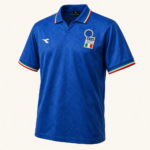
The Diadora shirt added tonal texture and tricolor trim to a runner-up campaign defined by Baggio.