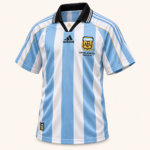
Argentina 1998 Home
The France ’98 Match Shirt
Broad stripes and a black collar for Batistuta’s France ’98 hat-trick.
- Manufacturer
- Adidas
- Kit Type
- Home
- Competition
- FIFA World Cup
- Location
- France
- Result
- Quarter-finals
- Archive ID
- KM-ARG-1998-H
Design Story
Argentina’s 1998 home shirt demonstrates how a familiar national design can be renewed without abandoning its visual foundation. The sky-blue and white vertical stripes remain central, but their relationship with the black collar, light-blue shoulder stripes and fine gold detailing produces a more layered composition than the comparatively restrained championship shirts of earlier decades. [1]
One of the most distinctive features is the centrally positioned black adidas mark. Moving the manufacturer’s identity away from its conventional position on one side of the chest changes the visual balance of the shirt. The mark occupies the central axis beneath the collar, while the association crest retains a separate position. The black neckline provides a strong contrast with the light body, and the finer gold accents introduce another colour at the edges without displacing the national palette. [1][2]
The World Cup configuration also carries a competition inscription beneath the AFA crest. [3] This detail gives the shirt a specific historical identity: it ties an established national design to the tournament in France rather than simply identifying its wearer as an Argentina player.
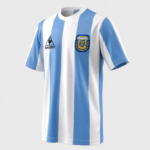
Compared with the 1978 adidas home shirt and the 1986 Le Coq Sportif design, the 1998 edition gives greater prominence to contrasting borders and the visual organisation of the manufacturer’s branding. [4] The differences show how the same striped identity could support changing design conventions across two decades.
For KitMosaic, the value of this shirt lies in that tension between continuity and change. It is recognisably Argentine, yet it also communicates the more elaborate visual approach associated with late-1990s football apparel. It represents an important point in the evolution of the national home shirt without requiring a departure from the colours that define it.
Tournament & Historical Context
France 1998 marked Argentina’s first World Cup after Diego Maradona’s international playing career had ended. Daniel Passarella, who had captained the championship team in 1978, now led the national side as coach. The tournament linked the country’s earlier football achievements with the ambitions of a different generation. [5]
Gabriel Batistuta became one of the defining players of the campaign. Argentina opened with a 1–0 victory over Japan and then faced Jamaica at the Parc des Princes in Paris on 21 June. Wearing the striped home shirt, Batistuta scored three goals in a 5–0 victory; Ariel Ortega contributed the other two. [2][5][6]
The performance established a direct historical connection with the blue away shirt of 1994. Batistuta had already scored a hat-trick against Greece in the United States, and the goals against Jamaica made him the first player to achieve hat-tricks in two different World Cups. [6] The two garments therefore document successive stages of one player’s international career as well as a change in the national team’s wider identity.
After completing the group stage with a victory over Croatia, Argentina faced England in the round of sixteen. A 2–2 draw was followed by victory in the penalty shoot-out. This match is essential to the campaign’s history, but Argentina wore the dark-blue away shirt, not the striped design represented in this archive. [5][7]
The home colours returned in the quarter-final against the Netherlands on 4 July. Argentina lost 2–1 after Dennis Bergkamp scored the late winner, ending the team’s pursuit of a third world title. [5][6]
Unlike the home shirts of 1978 and 1986, the 1998 design does not derive its significance from a championship victory. It recalls a talented generation competing in the years after Maradona, Batistuta’s exceptional scoring record and a campaign that combined memorable performances with disappointment. Its place in KitMosaic demonstrates why the history of football design cannot be reduced to a list of winners.
- Competition
- 1998 FIFA World Cup
- Location
- France
- Result
- Quarter-finals
Sources & Evidence
-
- Football Kit Archive — Argentina 1998 World Cup HomeTournament design reference.
-
- Getty Images — Batistuta against JamaicaContemporary match photography and visible design.
- Getty Images — Batistuta against JapanContemporary home-shirt reference.
-
- Football Shirt Culture — 1998 World Cup match-issue shirtVisual evidence for competition inscription only; does not establish match-worn provenance.
-
- Football Kit Archive — Argentina 1978 HomeEarlier design comparison.
- Football Kit Archive — Argentina 1986 HomeEarlier design comparison.
-
- FIFA — Argentina World Cup historyCoach, campaign, fixtures and results.
-
- FIFA — Batistuta’s two World Cup hat-tricksBatistuta’s record, Jamaica and Netherlands matches.
- Getty Images — Gabriel Batistuta against the Netherlands, 4 July 1998Contemporary quarter-final photograph of Batistuta in the striped home shirt.
- Classic Football Shirts — 1998–99 Argentina home shirt, Batistuta #9Retail listing for visual comparison with the home design.
- FBref — Netherlands v Argentina match reportQuarter-final fixture, date and match result.
-
- FIFA — Argentina vs England, France 1998Round-of-sixteen result and match context.
- Getty Images — Argentina vs England, 1998Away-shirt identification.
Supplementary sources
- Football Kit Archive — Argentina 1998 HomeGeneral home design comparison alongside the tournament-specific reference.
- FIFA — Argentina’s best World Cup momentsSupplementary context for Argentina’s World Cup campaigns.
- KitMosaic — Argentina 1986 HomeRelated collection entry for design comparison.
Evolution Line
-
1986
Le Coq Sportif kept the sky-blue and white vertical stripes for Argentina’s second World Cup title. The supplier changed while the home identity stayed recognizable.
-
Current
1998
At France 98, adidas kept the sky-blue and white stripes and added a dark fold-over collar, shoulder stripes and match-edition chest details.