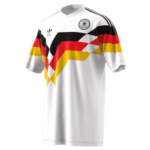
Germany 1990 Home
West Germany 1988–91 Home
The shirt that turned Germany’s flag into football’s most iconic chest graphic.
- Manufacturer
- adidas
- Kit Type
- Home
- Competition
- FIFA World Cup
- Location
- Italy
- Result
- CHAMPIONS
- Archive ID
- KM-DEU-1990-H
Design Story
The 1990 West Germany home shirt marks a shift in the way national colours could be incorporated into a football garment. White remained the foundation, preserving the familiar appearance of the German home strip, but adidas introduced a bold angular graphic in black, red and gold across the upper body. The national flag became a major compositional element instead of being confined to a small badge or peripheral trim. [1]
The graphic gives the shirt a distinctive directional movement. Its successive bands change angle across the chest, linking the upper torso to the shoulder area and creating a strong visual contrast against the white ground. The black shoulder stripes provide another directional element, while the association crest anchors the design in the established identity of the national team. The result is a balance between recognisable football conventions and a much more assertive use of geometry. [1]
This language belongs to the design transition of the late 1980s, rather than an invention that can be dated exclusively to the 1990 tournament. The national team had already adopted related black-red-gold graphics around the 1988 European Championship. [2] The World Cup subsequently gave this design family its most enduring championship association.
The shirt can also be read alongside the Netherlands’ 1988 home design. Both use pronounced geometry, but their visual strategies differ: the Dutch shirt uses a repeated pattern across an orange field, while the German design concentrates national colours into an angular band over white. [3] Each demonstrates a different way to combine a strong national identity with the more expressive graphic vocabulary of the period.
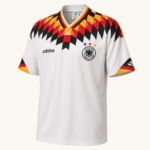
Later German shirts continued to reinterpret the flag colours, including the more expansive treatment documented by the DFB for 1994. [4] The 1990 design is an important reference in that evolution because it made national symbolism an integral part of the shirt’s visual structure.
Tournament & Historical Context
West Germany arrived at Italia 1990 after reaching the finals of the previous two World Cups without winning either. With Franz Beckenbauer directing the team and Lothar Matthäus as captain, the campaign represented another opportunity to convert sustained international competitiveness into a championship. The white home shirt with its national-colour graphic accompanied that pursuit. [5][6]
On 8 July 1990, West Germany faced Argentina at Rome’s Stadio Olimpico. The fixture repeated the final of 1986, but the outcome was different. Andreas Brehme converted a late penalty to secure a 1–0 victory and the third World Cup title for the German national team. [5][6] West Germany wore its white home shirt with the distinctive black, red and gold chest graphic, while Argentina appeared in its dark-blue away shirt. The encounter recalled the 1986 final, when Argentina wore its striped home shirt, but with a different visual contrast and a reversed sporting outcome. [6]
The championship occurred during an extraordinary period in German history. The Berlin Wall had fallen in November 1989, but the Federal Republic of Germany and the German Democratic Republic were still separate states when the final was played. German reunification formally took effect on 3 October 1990. [7] Consequently, the title belongs to the West German team before reunification, not to a team already representing a unified German state.
That chronology gives the shirt a particular cultural resonance. Its national colours can be interpreted retrospectively in relation to the transition taking place around the tournament, but the graphic itself predated reunification. It would therefore be misleading to claim that the design was originally produced as a celebration of the political event.
The garment connects the sporting memory of the 1990 final with a larger historical transition without requiring the two to be treated as identical. Its distinctive appearance helped give that moment a durable visual form.
Within the collection, the 1990 shirt is both a championship landmark and an example of national symbolism becoming a dominant design feature. It also provides a historical counterpoint to Argentina’s 1986 championship shirt, linking two successive World Cup finals through the changing fortunes of the same opponents.
- Competition
- 1990 FIFA WORLD CUP
- Location
- Italy
- Result
- CHAMPIONS
Sources & Evidence
-
- Football Kit Archive — Germany 1990 HomeWhite ground, tricolour angular graphic and shoulder stripes.
-
- Football Fashion — Germany 1988/91 heritage designSecondary retrospective reference for the earlier design family; not primary evidence for match details.
-
- Football Kit Archive — Netherlands 1988 HomeComparative geometric treatment.
-
- DFB — Homage to iconic Germany shirtsFederation retrospective on 1994 flag-colour design.
-
- DFB — Germany vs Argentina, 1990 finalFinal result, line-ups and scorer.
-
- FIFA — A magical night in RomeFinal date and winning penalty.
- FIFA — World Cup champions 1982–2026Championship chronology and contemporary trophy photograph.
- Museum of Jerseys — 1990 World Cup Kit Tracker: Knockout StageArgentina wore dark blue in the 1990 final, unlike its striped home shirt in the 1986 final.
-
- German Federal Government — Reunification, 3 October 1990Formal reunification date and political chronology.
Supplementary sources
- Museum of Jerseys — Franz Beckenbauer’s kit legacyRetrospective account of the 1988 design and its retention for 1990.
- FIFA — Germany’s World Cup titlesChampionship chronology and match facts.
Evolution Line
-
1988
Euro 88 debut
-
1994
Germany’s home identity became sharper and more graphic while keeping the white base.