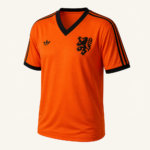
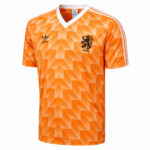
Netherlands 1988 Home
Netherlands 1988 UEFA European Championship Home
The orange geometric adidas shirt linked to the Netherlands’ first major title.
- Manufacturer
- Adidas
- Kit Type
- Home
- Competition
- UEFA European Championship
- Location
- West Germany
- Result
- CHAMPIONS
- Archive ID
- KM-NED-1988-H
Design Story
The Netherlands’ 1988 home shirt transforms a familiar national colour into a remarkably distinctive graphic composition. Orange had long provided the team with its visual identity, but this adidas design introduces a repeated geometric pattern that changes the appearance of the surface. Alternating tonal areas and diagonal lines break up the orange field, producing a sense of movement without obscuring the colour that identifies the national team. [1][2]
Orange occupies a special place in Dutch national symbolism because of its historical association with the House of Orange-Nassau. Its role in football is therefore not simply a reflection of the colours of the modern national flag. [3] In the 1988 shirt, this established cultural association is preserved while the visual treatment becomes considerably more expressive.
The white V-neck and white shoulder stripes provide relatively stable frames around the patterned body. The dark national association emblem introduces a compact point of contrast. These elements balance the complexity of the repeated graphic, allowing the design to remain recognisable both as an orange Netherlands shirt and as a product of the adidas visual vocabulary of the period. [1][2]
A comparison with West Germany’s 1990 shirt reveals two distinct uses of late-1980s geometry. The German design concentrates the flag colours into a dynamic angular chest graphic, whereas the Dutch design distributes its pattern across the body. [4] In both, the national team’s identity remains readable even though the graphic treatment is far more prominent than in many earlier international shirts.
The 1988 garment also has a particularly concentrated match history. The design is documented across the Netherlands’ five European Championship games, rather than being associated with a long sequence of unrelated tournament campaigns. [2] This narrow historical association strengthens the connection between its appearance and the sporting event.
For the collection, the shirt’s value is both aesthetic and historical: it shows how a familiar national colour can support a striking new visual language while remaining immediately identifiable.
Tournament & Historical Context
The Netherlands entered the 1988 European Championship in West Germany with an unresolved place in international football history. The celebrated Dutch teams of the 1970s had reached two World Cup finals without winning either. Under Rinus Michels, a later generation had the opportunity to turn that reputation for exceptional football into a major international title. [5]
The tournament began with a 1–0 defeat against the Soviet Union. Marco van Basten, who had started that match on the bench, then scored three goals in the 3–1 victory over England. The Netherlands advanced from the group and met the hosts in the semi-final in Hamburg. After falling behind to a Lothar Matthäus penalty, the Dutch equalised through Ronald Koeman and won through Van Basten’s late goal. [5][6]
The semi-final carried particular historical resonance because West Germany had defeated the Netherlands in the 1974 World Cup final. The victory in Hamburg did not reverse that earlier result, but it provided a new chapter in the rivalry and opened the way to the Netherlands’ first European Championship final. [6]
On 25 June in Munich, the Dutch faced the Soviet Union again. Ruud Gullit opened the scoring with a header, and Van Basten added the second goal with an extraordinary volley from a narrow angle. The 2–0 victory delivered the European title, with Van Basten finishing the tournament with five goals. [5][7]
The patterned orange shirt is closely linked to this sequence of recovery, breakthrough and triumph. Its visual identity accompanied both the initial setback and the final victory, giving the garment a meaning that extends beyond a single celebrated goal. The orange colour already carried national associations; the championship added a new layer of football memory to it.
The Royal Netherlands Football Association identifies the 1988 title as a landmark in its history. [7] In the collection, the garment connects the international reputation of the earlier Dutch teams with the generation that secured the European championship. Its design and historical significance reinforce one another, making it a particularly important example of how a football shirt becomes a lasting cultural reference.
- Competition
- UEFA EURO 1988
- Location
- West Germany
- Result
- CHAMPIONS
Sources & Evidence
-
- Football Kit Archive — Netherlands 1988 HomeOrange geometric design and white V-neck.
-
- Museum of Jerseys — Netherlands 1988Five tournament games and kit appearance context.
-
- BBC Sport — Why the Netherlands wear orangeHistorical association of orange with the Dutch royal house.
-
- Football Kit Archive — Germany 1990 HomeComparative angular flag-colour design.
-
- UEFA — EURO 1988: All you need to knowOpening loss, tournament chronology and Van Basten’s five goals.
- UEFA — Classics: Soviet Union vs NetherlandsEarlier World Cup finals, final rematch and tournament outcome.
-
- UEFA — Netherlands avenge West Germany lossSemi-final, venue, scorers and 1974 rivalry context.
-
- UEFA — EURO on this day: 25 JuneFinal date, score and scorers.
- KNVB — Dutch football history in briefFederation recognition of 1988 championship.
Evolution Line
-
1974
Orange home shirts were already central to the Netherlands’ international image.
-
1990
Later adidas Netherlands shirts continued the orange-first national identity.